Holiday Games the Whole Family Can Play Together
Kids, teenagers, parents and grandparents in one room? What makes a game work across ages, three kinds that do, and how to run one over the holidays.
Planck Scale StudioPublished 5 min read
Also available in: Italiano, Polski, Français, Español, Magyar, Deutsch
Dinner is over. Grandad has the armchair, the youngest is under the table with a new toy, and the teenagers are edging toward the stairs with their phones. Someone says "let's play a game" and comes back with the same trivia box as last year. Twenty minutes later, two people are still playing.
The holidays put three generations in one room, and most games are made for one of them. This guide covers what a game needs to work for all of them, the kinds of game that manage it, and how to run one without a row.
Why most games split a family
Trivia belongs to one generation. Questions about seventies television suit Grandma, and questions about this year's music suit the fifteen-year-old. Whichever box you open, half the room is guessing.
Long rules lose both ends of the table. By the fourth page of the rulebook, the seven-year-old has left and Grandad has fallen asleep.
Speed games reward young hands. Anything won by slapping a card first is over before the oldest players have found their glasses.
Elimination sends someone away. It's usually the youngest, and usually in tears.
Five things a mixed-age game needs
Before you choose, run the game past these.
- The rules fit in one sentence. If a six-year-old can repeat them back, everyone has understood.
- It needs no special knowledge. The best family games ask about the people in the room, which is the one subject everyone there knows.
- Everyone plays at once. A long wait between turns is when the phones come out.
- Rounds are short. You should be able to stop after ten minutes without anyone feeling the game was abandoned.
- People can drift in and out. Someone has to check the oven, and someone always arrives late.
A game that passes four of the five is worth trying. Few pass all of them.
Three kinds of game that pass
These are types of game, so you probably already own one of each or can make it with paper and a pen.
Guessing games about each other. Everyone writes down a fact about themselves that nobody knows, and the room guesses whose it is. You can also collect a baby photo from each person and guess who is who. A four-year-old's fact is as good as a grandmother's, and you will usually learn something about your own family.
Drawing and miming. Charades and drawing games work across ages because being bad at them is the fun part. Let people choose their own words, so that a child isn't stuck acting out a film from 1974.
Team games with mixed teams. Twenty questions, or the game where a name is stuck to your forehead and you ask yes-or-no questions to work out who you are. Played in teams, they give the youngest and the oldest someone to confer with.
How to run it
- Pick the moment. After the meal and before the film is usually best. During the washing-up is the worst time.
- Mix the generations. Grandparent and grandchild against parent and teenager works far better than children against adults.
- Give a child a job. A child who explains the rules or keeps score stays for the whole game. Our guide to explaining any game in a few minutes has a script short enough for a ten-year-old to use.
- Set an end before you start. "Three rounds" is easier to agree to than "a game".
- Stop while people want more. They'll ask for it again tomorrow.
Keep it peaceful
- Nobody has to perform. Guessing from the sofa counts as playing.
- Stay away from the annual argument. If a category leads to politics or to who was Mum's favourite, drop it.
- Give prizes, not forfeits. The last chocolate from the tin is a good prize, and losing shouldn't cost anyone anything.
- Give the reluctant one a role. The uncle who "doesn't do games" is often happy to be the judge.
- Let the children win sometimes, and don't make it obvious.
An example: Gallery Gamble
We make this game, so weigh this with that in mind. Gallery Gamble is a phone game of the first kind: a guessing game about each other, played with the photos on everyone's phone. Each player secretly picks a photo from a random grid of their own pictures. The photos then appear one at a time on every screen, and everyone taps the person they think each one belongs to.
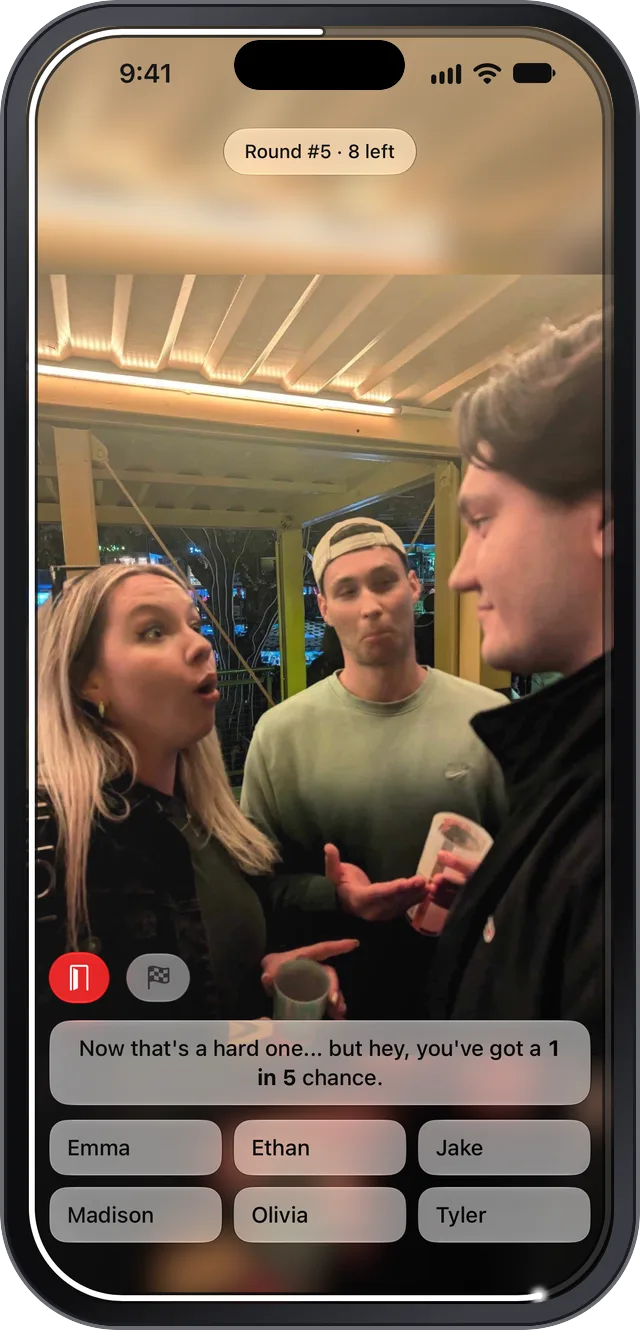
Here's how it does against the five points, including where it falls short:
- One-sentence rules? Yes. "A photo comes up, you guess whose it is."
- No special knowledge? Yes, as long as you know the family. Someone spending a first Christmas with the in-laws will be guessing more than the rest.
- Everyone plays at once? Yes. Everyone guesses every photo.
- Short rounds? Yes. The host sets the number of rounds and the timer.
- Easy to drift in and out? This is its weak point. Every player needs their own iPhone or iPad, so anyone without one watches over a shoulder. It also needs at least 3 players in the same room.
That last point matters at a family gathering. If Grandma has an Android phone, or no smartphone, this isn't a game for the whole family, and one of the paper games above will suit you better.
If you do play it, look through your photos first, and go through the settings together with any children who are playing. Our guide to keeping private photos out of camera roll games explains how, and has a section for parents.
The short version
Choose a game about the people in the room, with rules a six-year-old can repeat. Mix the generations, agree on an end before you begin, and stop while everyone still wants another round.