Stag Do Games: Why In-Jokes Beat Forfeits
Planning a stag do or bachelor party? Why forfeits wear thin, and how the best man can fill the gaps with games built on the group's own stories.
Planck Scale StudioPublished 5 min read
Also available in: Italiano, Español, Français, Deutsch, Magyar, Polski
The minibus left at seven. It's half past nine, the service station coffee has worn off, and there are two more hours of motorway. Someone at the back says "right, forfeits" and holds up a list he printed off the internet. The groom's future father-in-law looks out of the window.
A stag weekend is mostly gaps. You've booked the karting and the restaurant, but nobody plans the drive, the wait for the table, the hour before the taxi or the morning after. This guide is for those gaps, and for the best man who has to fill them.
Why forfeits wear thin
They're the same every time. That printed list would work just as well for a groom you'd never met. Nothing on it is about him.
They have one target. That's funny for twenty minutes. After that, the job of the weekend becomes embarrassing one man for two days.
They escalate. Each forfeit has to beat the last one, and by Saturday night the next one is a bad idea.
They split the group. A few people love them. The rest go quiet, and it's usually the ones who know the fewest people.
What the group already has
Add up the years. The school friends have known him for twenty, the university lot for twelve, the people from work for five. Every one of them has a story about him that the others haven't heard.
That's hours of material. It costs nothing, and it fits in a minibus.
So the best man doesn't have to be the funny one. He has to get the stories out of the people who have them.
Get the groups to mix
A typical stag do has school friends, university friends, colleagues, a football team, a brother, a father-in-law, and the bride's brother, who knows nobody. Left alone, they'll sit in those groups until Sunday.
A few things break that up:
- Mix the teams. For any game, and for the karting too, put one person from each group on every team.
- Introduce people with a story. "This is Tom, he was there the night the hire car went missing" gets a conversation going. "This is Tom, he works in insurance" doesn't.
- Give the outsider a job. Whoever knows nobody can keep score or be the judge. It gives him a reason to talk to everyone.
- Ask the father-in-law for a story. He's the only one who knows how the groom did the first time he came for dinner.
Three formats that need nothing
True or made up. Someone tells a short story about the groom. It's either true or invented on the spot. Everyone votes, and the groom confirms. It works because the true ones are usually harder to believe.
Who was there? The best man names an event: the missed flight, the camping trip, the night with the hire car. Everyone who was there tells his version. No two versions ever match, and the groom decides whose is closest.
The partner quiz. Ask the groom's partner ten questions before the weekend and write down the answers. He has to match them. Choose questions with a story behind them. "What did he cook the first time you came round?" will get you further than a shoe size.
None of these needs props, a table or a phone signal, so they'll work on a bus, in a queue or in a pub. Keep each round under twenty minutes and stop before it drags.
One bit of preparation helps a lot. Before the weekend, message everyone and ask for the headline of his best story about the groom. You don't need the story itself. You only need to know who to call on.
Roast him without making it mean
He should be laughing as hard as everyone else. A few rules keep it that way:
- Use the speech test. If he'd tell the story himself at the wedding, it's fine. If he'd have to explain it at home, leave it out.
- Look at who's in the room. His father-in-law and his boss will hear the same stories as his oldest friends.
- Leave exes out.
- Go for things he did, not things he is. The time he locked himself out in a towel is fair. His hairline, his salary and the job he lost are not.
- Give him one veto, with no questions asked.
- Agree on phones at the start. Decide what gets filmed and what goes in the group chat. A story told in a pub is gone by morning, and a video isn't.
- Let people sit out.
An example: Gallery Gamble
We make this game, so judge it with that in mind. Gallery Gamble is a phone game built on the same idea. The material is everyone's camera roll.
Each player gets a random grid of his own photos and secretly picks one. The photos then come up one at a time on every screen, and you tap whoever you think each one belongs to. Your own photos come up too, and you still have to tap yourself. If you tap someone else, you've fooled yourself and you miss the points.
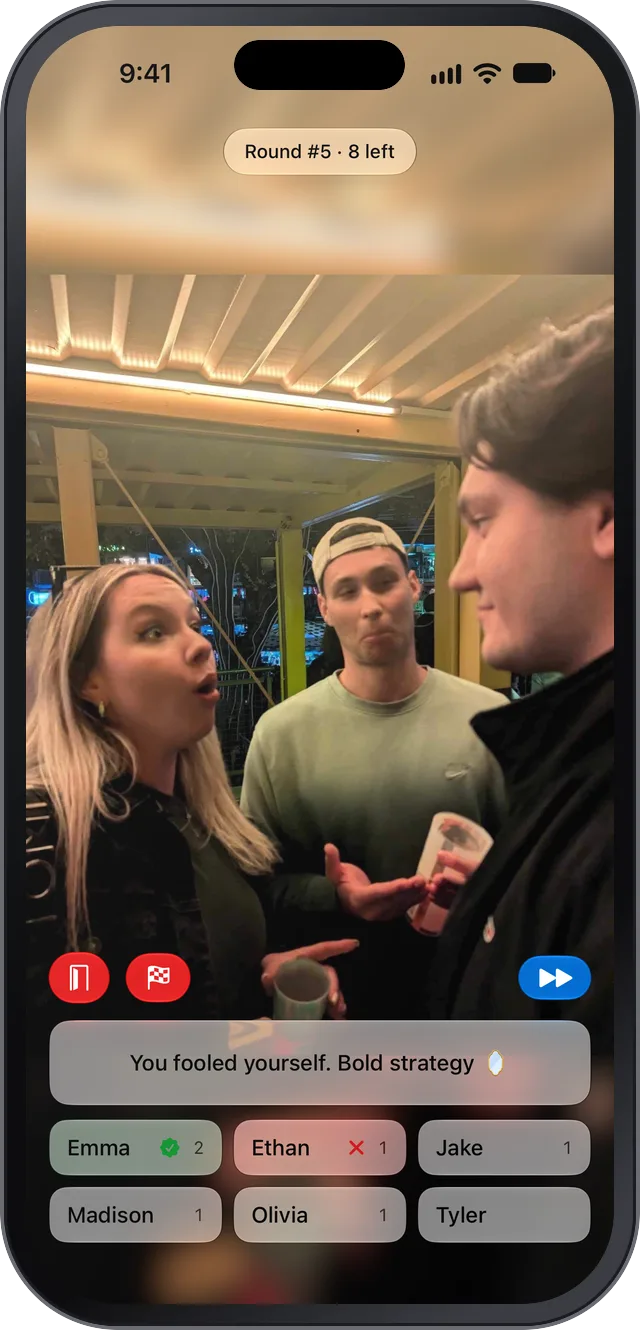
Here's why it suits a stag weekend:
- It fits a gap. The host sets the number of rounds, so a game can be as short as the wait for the table.
- It doesn't need a signal. The phones connect to each other directly, so it works in a cabin in the hills. Wi-Fi has to be switched on, but there's no network to join. Our guide to games that work without signal explains how to check that before you go.
- It starts fast. There's no account. Everyone types in the code from the host's screen.
- There's a way out. If a photo in your grid shouldn't be seen, re-roll it and you'll get another. You can also limit the game to photos you've chosen, which our guide to keeping private photos out of camera roll games covers.
- The photos stay with the group. They go to the phones in the game, not to a server.
It has limits. It runs on iPhone and iPad only, so check before you count on it, because a group of fifteen usually includes an Android phone. It needs at least 3 players, close together. It's also about everyone's photos, not only the groom's. That makes it a good way to fill a gap, and it won't be the main event.
The short version
Forfeits would work on any groom, and the stories only work on yours. Find out who has them, mix the groups, keep each round short, and give him a veto.